
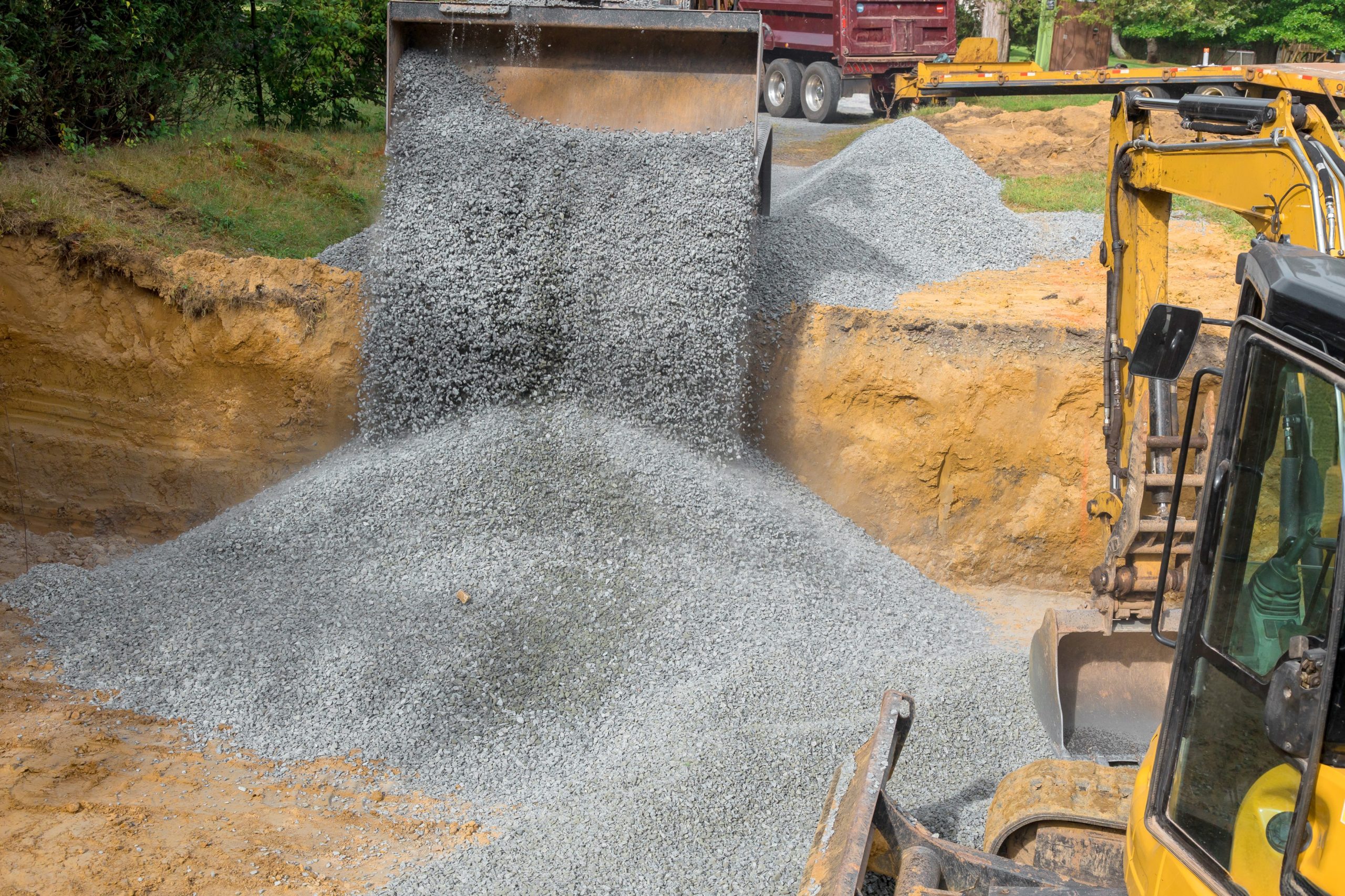
Construction projects thrive or die on one thing most people never think about until it’s too late: materials. You can have the best team, the best weather, and the best schedule, but if your sand and gravel supplier doesn’t deliver, your entire project comes to a standstill.
So, what does it take to find the right sand and gravel supplier? It’s not just about finding someone who can deliver a load of gravel to your driveway; it’s about finding a supplier who understands construction schedules, knows their products like the back of their hand, and actually delivers when they say they will. Whether it’s pouring a foundation, building a roadbed, or working on a landscape project, the quality of your sand and gravel directly affects the quality of your finished product.
Companies like ASR Materials have built their business on understanding what construction professionals and project managers need most, which are great service, reliable product quality, and knowledgeable support that doesn’t waste your precious time. Now let’s see what sets the pros from the pretenders.
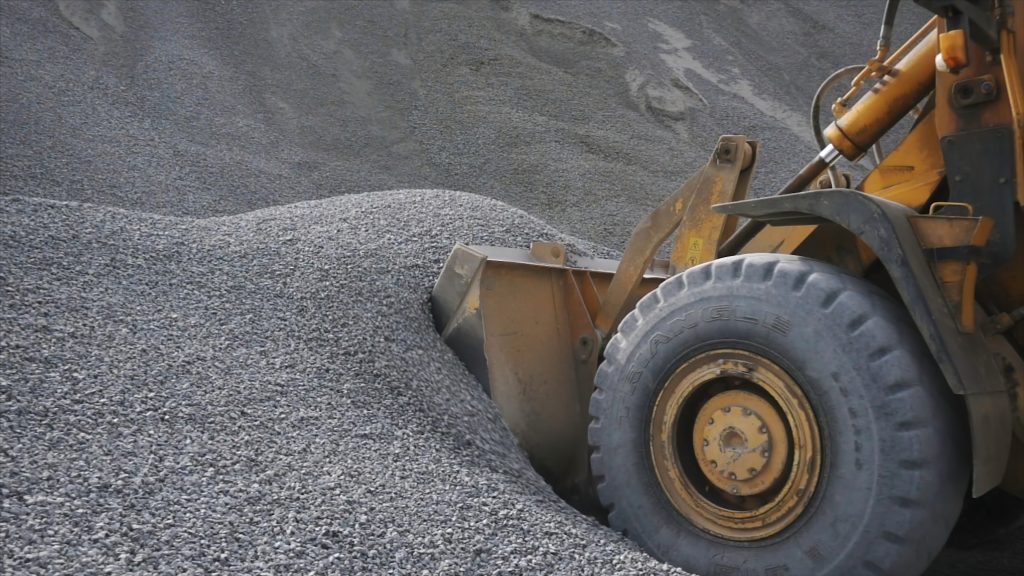 What Makes a Quality Sand and Gravel Supplier
Aggregate suppliers do not all work in the same manner. Some serve their customers as if they are ordering a pizza; order, deliver, and leave. The good ones? They ask questions. They would like to know what you are developing, the time scale you have, and whether you have taken into consideration the rates of compaction.
What makes a quality supplier different from the rest?
- Regular quality testing of products.
The good suppliers test their materials and are able to give specifications on all materials, such as gradation and moisture content. They are not simply picking up random heaps and dumping them in trucks, but they are tracking their inventory grade and type so that whatever you ordered three weeks ago is what you get today.
- On-time delivery.
If a supplier tells you they’ll deliver on Thursday morning but end up showing up Friday afternoon, they just lost you a day of labor and possibly a few thousand dollars in penalty clauses from the guy you’re working for. Quality suppliers take their delivery schedules seriously because they know you don’t have time for delays.
- Large selection of products.
Base stone, drainage rock, concrete sand, decorative landscape material; quality stone suppliers have several choices. Limited inventory implies that they will sell whatever they have, as opposed to what your project actually requires.
- Experienced service by those who know about construction.
If you call the supplier with a question, you shouldn’t have to be transferred three times just to find someone who knows what ‘AASHTO #57’ is.
Types of Sand and Gravel for Your Construction Project
If you walk into any good supply yard, you’ll see a dozen different types of aggregate piles. Each of these has a specific purpose, and the wrong type of aggregate can ruin the entire project.
Sand types for different uses:
- Concrete sand is finely graded and is washed clean. This is what goes into the concrete mix, along with cement and other aggregates. The wrong type of sand in concrete means that the concrete mix will not be of proper strength.
- Masonry sand is finer than concrete sand. This is what you use to lay brick or block. Concrete sand in masonry will cause joint problems in the future.
- Fill sand is good for general grading and filling, but is not strong enough for any other use. It is the cheapest of sands, and it is not interchangeable with concrete or masonry sand.
There are more types of gravel than most people think:
- Pea gravel is small, round, and perfect for pathways or other decorative uses in the yard. It is comfortable to walk on, drains well, but does not compact well for vehicle traffic.
- Crushed stone has angular edges, which help in locking the stones together, especially when used for the base and for driveways. The angular edges ensure that they lock together when compacted, thus providing a solid surface for heavy use.
- River rock is smooth and comes in different sizes, thus being suitable for drainage and decorative work. River rock does not compact well, though, and is best used for drainage and decorative work, where the flow of water is needed.
Construction aggregates for structural work have to be of specific gradations. The base course for a road requires dense graded aggregate, which will compact well and provide a solid base for the road. Drainage stone requires an open graded aggregate to allow for the flow of water. Foundation work requires a combination of dense graded stone for the base and drainage stone for the top, before the pouring of concrete.
The aggregate mix used depends on the specific application. Asphalt requires specific sizes and types of stone. Utility trenches require stone that will compact well but not harm the pipes. Erosion control requires large, angular stone to resist the movement of water. A good supplier will be able to provide the right stone for the job, rather than just any stone they have in stock.
Delivery Service: What to Expect from Top Suppliers
Delivery makes or breaks your relationship with a supplier. You can have the best sand and stone in the area, but if it does not arrive when promised, it does not matter.
What a professional delivery service looks like:
- Flexible scheduling that works around construction timelines. They know that saying “Tuesday” is not good enough when you have a concrete truck scheduled to arrive on Tuesday at 10 a.m. They will contact you and confirm a time and day, and if they are running late, they will call and let you know.
- A delivery driver who knows how to place materials properly. A good delivery driver will know how to offload the materials in a way that will save you the hassle of having to move the materials around the site. They know the terrain and will not destroy your driveway getting in and out.
- They have the right equipment for the job. When you are talking about a bulk delivery, this usually means a triaxle dump truck carrying 15-20 tons of material. For a smaller job, it might be a single-axle dump truck. The right equipment saves you money and prevents damage to your site.
- Good communication about access. A good supplier will ask you questions about your site, such as the width, overhead clearances, weight restrictions, and turning radius, before sending a delivery truck that will not fit.
Location is a factor in whether or not a supplier can deliver economically. Hauling materials over a great distance can get expensive very quickly, and those costs will be passed on to you. However, a local supplier will generally have a lower price for delivery, although special materials may require travelling over a long distance.
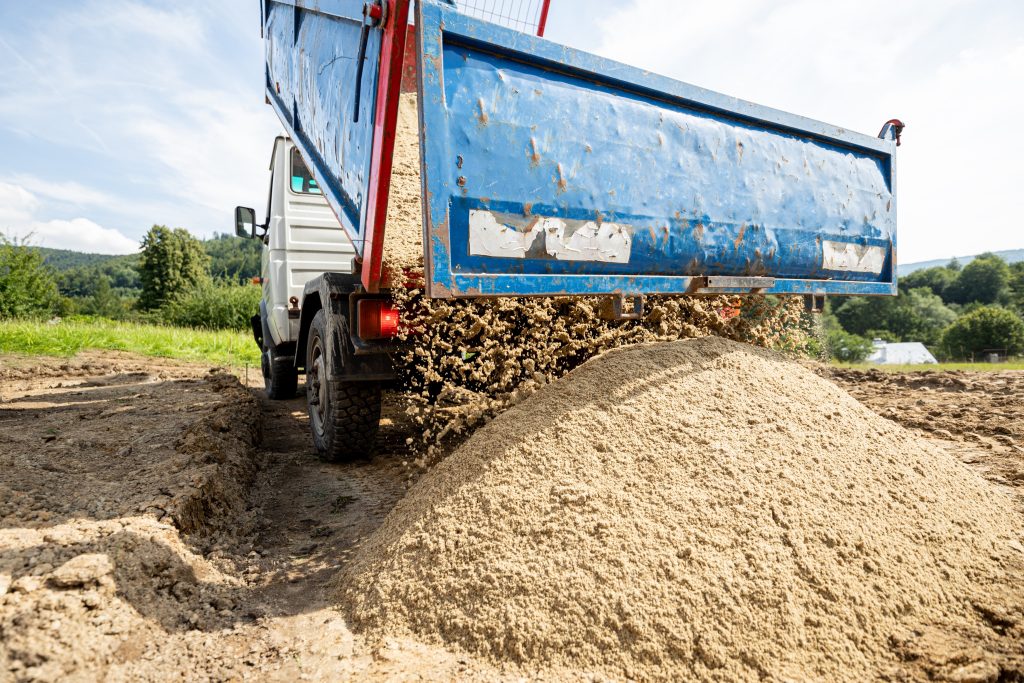
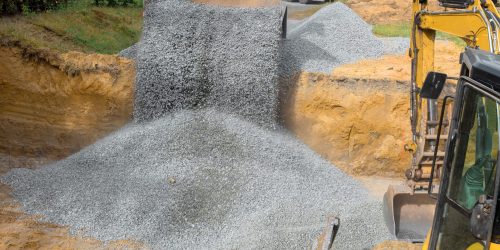
Also, note that the unloading of materials happens very fast. The driver will tilt the bed, the materials will fall out, and the truck will be gone in a flash. You need to know exactly where you want it, because moving a pile of gravel is a job in itself.
 Evaluating Suppliers in Your Region
Finding a supplier is not difficult, but finding a good one is a bit trickier. First, you should check what they actually stock. If they have a limited selection, they are more likely to try to sell you what they have on hand, rather than what you need. Look for operations that have a variety of sand, gravel, and stone in different sizes.
What to look for in a supplier:
- Quality of the products they offer. Do they test their products? What are their testing procedures? Can they provide certifications for the materials they deliver to you, should you need them? State DOT-approved materials, for instance, come with documentation. If they cannot or will not discuss testing procedures, they are probably not testing anything.
- Clear pricing. What are all the costs, and are they comparable? Be careful of the low bidder. A slightly more expensive supplier that will be on time with the correct materials is better than a cheaper option.
- Customer reviews. Look for patterns. Everyone has a bad day now and then. However, if they have a lot of complaints about delivery time, quality of materials, or customer service, you should be wary.
- Location. If you can find a supplier within twenty miles of you, they are probably a better choice than one fifty miles away. Suppliers in your local area are more likely to be familiar with local building codes and common project needs in your area.
The level of commitment a supplier shows to customer service is a great way to gauge the level of commitment they will show in case of a problem. Things break, the weather interferes with deliveries, and mistakes are made. It is not a matter of if, but when.
Moving Forward With Your Material Selection
Ultimately, the key to selecting the right sand and gravel supplier is the quality of the products, the quality of the service, and the quality of the support. You’re not simply purchasing a product; you’re purchasing the assurance that your project will not come to a grinding halt because the product did not arrive or did not perform as expected.
Take the time to research the right sand and gravel supplier even before you actually need them. Develop relationships with the operation that prides itself on customer service and product quality. When deadlines tighten and weather windows close, the right supplier will be the difference between a project that gets done on time and one that gets bogged down in costly delays.
If you are in South Florida and its environs, ASR Materials is your best bet. They offer the right combination of products, service, and support required for your construction project. Whether building infrastructure, laying foundations, or designing landscapes, working with the right supplier means working with people who consider your schedule as important as their own.
LOOKING FOR THE BEST SUPPLIER IN SOUTH FLORIDA?
YOU FOUND US, ASR MATERIALS.
SHARE POSTS
RELATED POSTS
March 4, 2026
Every successful construction project begins well before the foundation is laid. It starts with acquiring the right materials from the right supplier. The construction environment…
February 10, 2026
Construction projects thrive or die on one thing most people never think about until it's too late: materials. You can have the best team, the…

January 19, 2026
Silica sand is one of the most popular building and industrial materials used in the US. The statistics of the U.S. Geological Survey indicate that…
December 5, 2025
The construction and landscaping sector in South Florida is mainly dependent on sand of high quality to establish strong, smooth, and stable infrastructure that lasts…
November 7, 2025
South Florida construction is not an industry that takes kindly to inaccuracy. It’s expected. The following details are of paramount importance, as your foundation materials can only…
October 10, 2025
In South Florida, the weather tends to humble every building endeavor. Miami-Dade County alone averages more than 60 inches of rain per year, most of…